
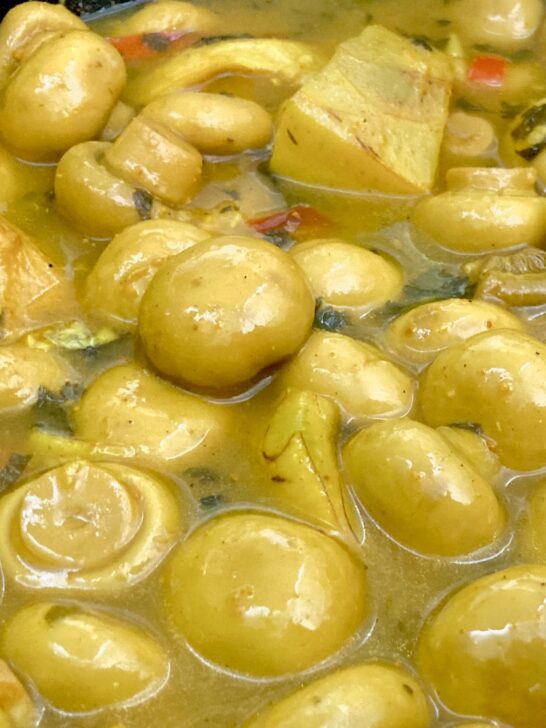
Mushroom-Artichoke Bottoms Salad is a delightful sour salad. An all seasonal recipe as the artichoke bottoms are frozen and the mushrooms are canned.
Either you’re an artichoke lover, or you’re not. Same goes for mushrooms. But if you love both, you’ve hit the jackpot, and you’re in for amazing sour artichoke bottoms-mushrooms experience. Served hot or cold.
Lemon juice, a red bell pepper, fresh cilantro and parsley leaves, and fresh garlic. Did you guess how the glossy yellow tint is created? Read on to find out.

An artichoke is an herbaceous thistle plant, and not a vegetable.
This plant has long stems (like tentacles). There are gigantic flower heads at the tips of each stem. These heads are harvested Lower down on the stems you’ll get smaller flower heads. Lower The heart and leaves make up the flower head of this plant. The artichoke plant is grown and harvested for its flower heads (around 8 heads on each plant). They must be
Supermarkets most commonly carry artichoke hearts of the Globe (French, Green) artichoke plant.
This is especially true for stuffed recipes, as this Beef stuffed artichoke hearts recipe.
What kind of hearts are not suitable for this recipe?
When you find canned or jarred artichoke hearts at your local supermarket, chances are that they are no other than artichoke baby hearts.
That being said, they could very well be the hearts that look like those in the image just below.
Meaning, those cans or jars could very well be artichoke hearts that were carved out of more mature artichoke heads. If this is the case, you can get the jarrd or canned kind at your local store.
But on the most part, the majority of canned and jarred artichoke hearts found at grocery stores are those of baby hearts.
What about baby hearts?
They are luscious and charming in many recipes, as oven-roasted recipes.
The thing is that if what you have inside those jars or cans are baby hearts, then we have a structural issue, in that you cannot stuff them or slice them into quarters or halves, simply because they have no suitable structure for that.
Why is this so?
A description of the structure of baby artichoke hearts
As alluded to earlier, the structure of baby hearts is very different than the more mature artichoke hearts.
How so?
They are sold spilt into halves, and the hearts are barely noticeable. This is true about how they appear in the image on the label.
What you can’t miss on the label image on these baby hearts jars and cans, though, is an abundance of leaves. These leaves are the inner leaves of the artichoke head. They are very soft and edible and are used in many roasted recipes.
However, as mentioned above, they are not the kind you need for this recipe.
So, you don’t need baby artichoke hearts here. Unfortunately, the phrase ‘baby hearts’ might not appear on the label as well. So, please decide if what you have accessible is, indeed, the cup shape hearts, or the baby hearts, with all of the leaves.

where You could find frozen artichoke hearts
- Many areas only carry frozen artichoke hearts in Mediterranean stores. I love these kind of stores and definitely think they are worth checking out.
- If not, yet you love Mediterranean products or are trying to accustom yourself and your family to a Mediterranean diet, I’d recommend finding your favorite Mediterranean products supplier on the Internet.
SO, It’s no secret: i prefer using frozen hearts.
I advise using frozen hearts. That being said, for using canned or jarred cup-shaped hearts, which as previously discussed, is the shape we need here, I’ll give you general guidelines a bit further on below on how to use them in this recipe.
For now, I’ll explain how to use frozen artichoke hearts in this recipe.
Here’s an idea of how it’s done.
I try to keep recipes as simple as possible, without compromising health:
- All you do is pop open a package of frozen artichoke hearts (‘bottoms’).
- While still frozen, slice them down the middle once, or twice (depending on their size).
- Give them a good sauté in a medium size non-stick pot, with a red bell pepper, fresh garlic, two types of herbs and one main spice, namely turmeric, (besides salt and pepper).
- Add canned (or fresh) mushrooms, and lemon juice.
- Serve hot or cold; as an appetizer, or as a starter salad. For fresh mushrooms, see the instructions at the end of this page.


Just going over the info up until now. If you’ve got it, you can just skip to the subtitle:
The Advantages of Frozen Artichoke Hearts, or scroll down to the recipe below.
2 Types of Artichoke Hearts Sold at Different GROCERY STORES
There seems to be much justifiable confusion with regards to what artichoke hearts look like.
The reason is because there are 2 types of store-bought hearts: hearts from mature artichoke heafs, and baby hearts from less mature artichoke heads.
Type 1:
Artichoke hearts from more mature artichoke heads: They have a cup-shape. They are from 1-1/2 inches to 3-1/2 inches in diameter and are carved out of more mature artichoke heads (flowers). See the image below.
Summary of Artichoke hearts from artichoke heads that have matured longer:
They are yellow and have the shape of a cup.
The following image displays two yellow cup-shaped hearts (that appear in the bottom of the image). This is what they are supposed to look like for this recipe.

Type 2:
Artichoke hearts from baby artichoke heads: The hearts are barely noticeable because they are so small. They are attached to their surrounding soft, thin, and edible bract (leaves). They are packaged (jarred/canned) as artichoke halves. It doesn’t explain this on the package.
Summary of: Artichoke hearts from baby artichokes heads:
Jars and cans featuring an image with leaves, but with no noticeable cup-structure, are baby hearts. Cute as they are, they are not the large cup-shaped hearts type you need for this recipe, as mentioned above.
As mentioned above, they are not suitable for other recipes above, such as stuffed artichoke hearts recipes.
Summary of the type of hearts you need for artichoke and mushrooms in turmeric salad.
- You need hearts that were cut out of more mature artichoke heads.
- If there are a ton of leaves split in half in the label image, this is not what you need. These are the baby type.
- They have a natural cup-shape.
- These heart shapes, also called ‘artichoke bottoms’ look and function the same whether they’ve just been freshly carved out of an artichoke head, or if they are frozen in a package at the supermarket.
ARE THERE FROZEN BABY ARTICHOKE HEARTS?
While there could be frozen baby artichoke hearts (leaves and all), I’ve never come across such a product. I’ve never heard of frozen artichoke hearts that are not the cup-shape type.
Cooking with frozen artichoke hearts has its advantages.
The Advantages of Making These Dishes with Frozen Artichoke Hearts
So, what are the benefits of using frozen artichoke bottoms versus the jarred or canned hearts?
Frozen hearts are the closest to fresh/raw artichokes hearts (that they use at gourmet restaurants) as you can get as far as texture, flavor and aroma go. For the sake of the following explanation, I’m going to refer to the artichoke hearts as though they were a type of vegetable, though, as mentioned above, they are not.
Texture:
- Frozen artichoke hearts seem to be cooked less than canned or jarred hearts.
- Therefore, canned and jarred hearts need to be cooked less time, so they don’t fall apart.
- Canned and jarred hearts remain in a liquid for months at a time. It’s no secret that vegetables that lie in a liquid end up having a watery texture. It’s harder to cook with a watery texture, as it might be more prone to become mushy or fall apart. As with frozen artichoke hearts, this is not the case. They are par-boiled, then frozen. This preserves their original texture to a great extent.
Flavor:
- Canned and jarred vegetables absorb the flavors of the liquid, taking them further away from their original flavors in their raw form. Canned hearts are preserved in an acidic agent, thus affecting the flavors even more than jarred hearts.
Aroma:
- The aroma of frozen vegetables is harmed less than those that are canned or jarred, once again, because they absorb flavors from the liquid.
What is important to know if you are using canned or jarred bottoms?
So, if the only accessible artichoke hearts you have are the canned or jarred (cup-shape) kind, then it’s important to know a few things:
1. Because jarred or canned hearts come more cooked than frozen artichoke hearts (bottoms), it’s important to cook them less time than called for in the recipe. So, please carefully monitor their degree of softness. Definitely, I wouldn’t give them a pre-fry in the pot (as is the case of the frozen hearts). I would just sauté most ingredients, including the mushrooms, and then add the the water. Simmer everything for 10 minutes and add the jarred or canned hearts (sliced) 5 minutes before the end of the cooking time.
2. For canned hearts (I undersand that this is not so for jarred hearts, but please taste which ever type you are using (jarred or canned) and decide if you need to take care of an over-acidic flavor.
How to Rid of an Over-Acidic Flavor
Pre-soak in cold water for an hour or so. The strong flavor won’t completely disappear.
Learn how I make:
Turkey stuffed artichoke hearts.
Preparing This Recipe with Fresh Mushrooms
As mentioned above, you can use canned, or fresh mushrooms.
For canned mushrooms:
- just follow the recipe instructions.
For fresh mushrooms:
- slice and boil in water for 5 minutes;
- continue with the recipe from the point where it says to toss the mushroom into the pot with the other ingredients.
I hope you enjoy this lovely and extremely delicious cooked salad.
I’d love for you to share your thoughts in the comments below.
Check out the benefits of a Mediterranean diet according to Mayo Clinique.
Best Ever Artichoke Hearts with Mushrooms in Turmeric Salad

Sour aritchoke hearts, mushrooms, fresh parsley, chopped celery stalk, red bell pepper: Our family favorite starter recipe.
Ingredients
- 8 medium to large frozen artichoke hearts (bottoms), cut into quarters (while frozen)
- 2 pounds / 1 kilo (approx)
- 5 garlic cloves, crushed
- 1 small red bell pepper, cut into 1/2" cubes
- 1½ cups freshly chopped cilantro leaves + some stems
- 1½ cups freshly chopped parsley leaves
- 1/4 teaspoon black pepper, or to taste
- 1/3 cup lemon juice
- 2 + 1 tablespoons turmeric powder
- 3 teaspoons kosher salt + 1½ teaspoons table salt, or to taste
- 1/4 cup neutral oil
- 4 cups hot water
- 3 tablespoons wheat flour
Instructions
Cooking
- Saute frozen artichoke slices in 1/4 cup oil 5 minutes. If they defrost, it's fine.
- Add red pepper, saute antoher 5 minutes.
- Lower heat, add 2 tablespoons of turmeric and 1/4 teaspoon of black pepper, the crushed garlic, stir 1 minute.
- Add lemon juice and cilantro leaves.
- Toss mushrooms and parlsey leaves into pot, add another 1 tablespoon turmeric powder, 3 teaspoons Kosher salt, bring to boil, then simmer stir 5 minutes.
- Add 4 cups of hot water (thought not boiling).
- Next, toss in the wheat flour or (gluten-free) potato starch.
- Sitr, bring to boil, cover pot, then lower heat again and simmer 15 minutes.
- Adjust saltiness with table salt, and not Kosher salt. I add another 1 teaspoons table salt, but please add salt to taste.
- If you used fresh (raw) mushrooms instead of canned, taste for texture preparedness. If it necessary, cook for another few minutes.
- Remove from heat, and set aside 20 minutes to let flavors absorb well. Adjust saltiness and sour tang if necessary.
Notes
If it's too salty, add a cup of chopped parsley and another 1 cup hot water. Bring to boil and immediately turn off heat. Set aside.
Substitute fresh parsley leaves instead of cilantro.
Please do not use dried parsley or cilantro.
Substitute potato starch instead of wheat flour for a gluten-free dish. Make sure to use a non-stick pot and
Nutrition Information
Yield
6Serving Size
1Amount Per Serving Calories 122Total Fat 10gSaturated Fat 1gTrans Fat 0gUnsaturated Fat 8gCholesterol 0mgSodium 1182mgCarbohydrates 9gFiber 2gSugar 1gProtein 2g
Nutrition values are estimated.